Planning permission or prior notification? How to know which applies to your works

The choice between planning permission and prior notification determines the waiting time, the allocation of risk and how the works begin. With Decree-Law n.º 108/2026 — in force on 3 August 2026 — the border between the two routes became clearer: where planning parameters are defined, the route is prior notification.
What distinguishes the two routes
Planning permission (licença) is the procedure with municipal assessment: the council analyses the design and decides. It remains the route for operations with more room for appraisal — construction in areas without defined parameters, listed buildings or buildings undergoing classification, subdivisions without a covering plan.
Prior notification (comunicação prévia) is the route for areas where the rules of the game are already written — detailed plan, subdivision permit, parameters defined in the PDM. The designer assumes conformity through a statement of responsibility; from 3 August, the preliminary-check phase ceases to exist: fees paid, works under way, and successive municipal control within one year.
Side-by-side comparison
| Criterion | Planning permission | Prior notification |
|---|---|---|
| When it applies | Operations without defined parameters; listed heritage; subdivisions without a plan | Areas with defined parameters (PP, subdivision, PDM) |
| Municipal control | Prior — the council assesses and decides | Successive — inspection up to 1 year after the start |
| Start of works | After approval (express or tacit) and title | With fees paid and the start date notified |
| Decision deadlines | 30 days for the architecture (+30); deliberation in 20 | No prior decision — the procedure is declaratory |
| Where the risk sits | Shared with municipal control | In the rigour of the design and the statement of responsibility |
Source: DL n.º 108/2026 and consolidated RJUE.
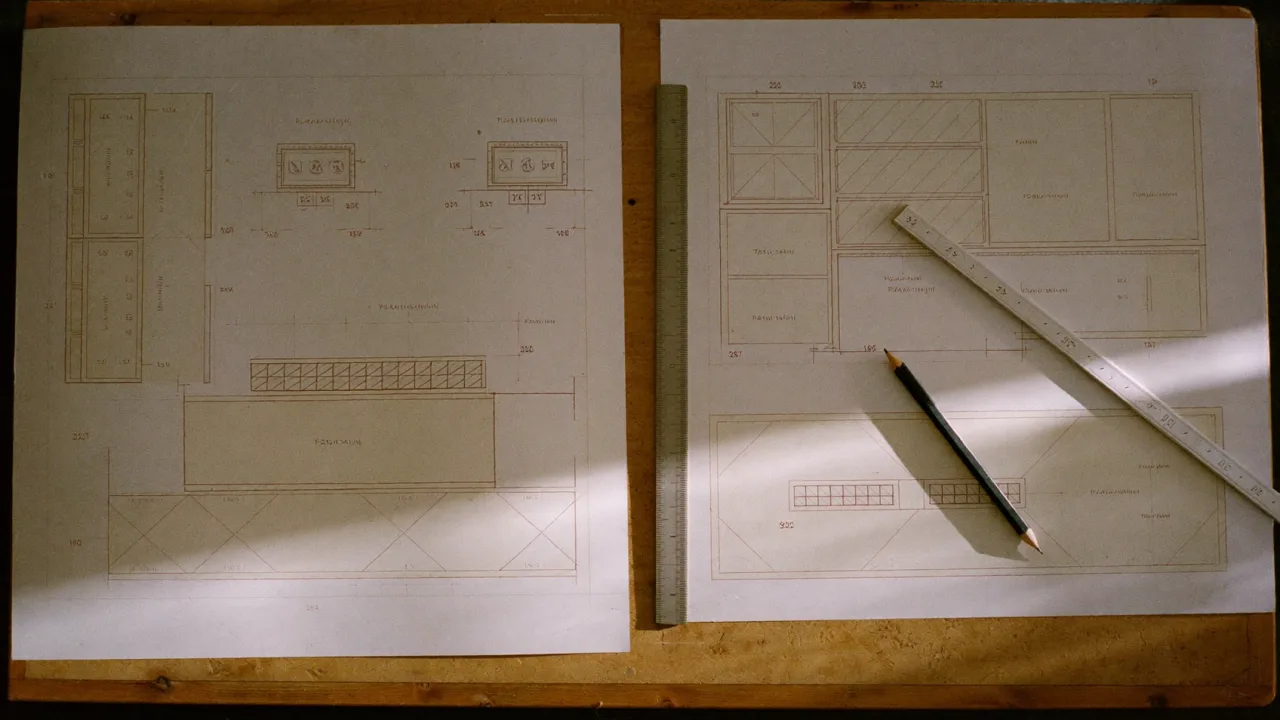
Two routes, one design: the difference lies in who verifies conformity — and when.
Three questions to decide
1. Does your area have defined planning parameters? If the plot is covered by a detailed plan, a subdivision permit or clear PDM parameters, prior notification is, as a rule, the route. 2. Is the building listed or in a protection zone? Then the route is planning permission, with the applicable external consultations. 3. Is the operation exempt? Works of minor planning relevance and interior alterations without structural impact require neither route.
Listed building or in a protection zone?
includes buildings undergoing classification
yes
PLANNING PERMISSION
no
Does the area have parameters defined in a plan?
PP, subdivision or PDM
yes
PRIOR NOTIFICATION
where there are none, the route is planning permission
Two questions resolve most cases — the third (exemption) is confirmed in article 6 of the RJUE.
“When in doubt, the answer is not to gamble on the wrong route — it is to request a prior information request (PIP): it fixes the rules of your case before you spend a euro on design.”
Tiago R. Correia
Architect
Want the full picture — exemptions, deadlines, tacit approval and what changes on 3 August? It is in the 2026 building permitting guide.
What if the works are exempt?
There is a third path that is neither permission nor prior notification: exemption from prior control, for works of minor planning relevance and interior alterations that do not touch the structure, the façades or the building height. Mind the detail many people ignore: exemption from procedure is not exemption from rules — the PDM and the technical standards still apply, and in listed buildings the exemption disappears. The full framework is in the 2026 permitting guide.
Frequently asked questions
What happens if I use the wrong route?
The application is rejected at the preliminary assessment — losing weeks or months. It is the plot’s planning assessment, done at the start, that avoids that cost.
Is prior notification cheaper?
Fees vary from municipality to municipality and with the size of the operation. The relevant difference is not in the fees: it is in the time to start and in who carries the conformity risk.
Can I start the works as soon as I pay the fees?
Under prior notification, from 3 August 2026, yes — fees paid and start date notified. Until then, the current regime’s 20-day tacit admission applies.
Not sure which route your project takes?
We send you the planning assessment of your plot — route, deadlines and constraints — before any commitment.
-
No tags found