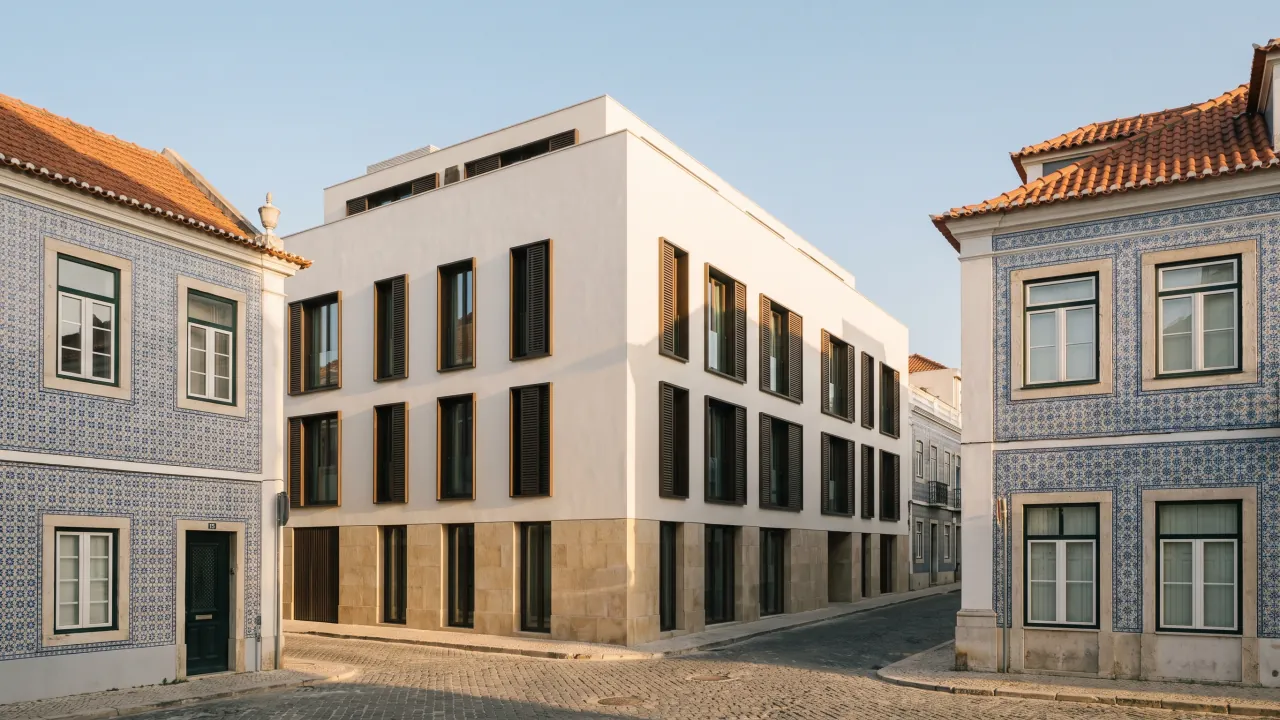
Local accommodation or tourism development?
Anyone who wants to turn a property into guest accommodation faces two regimes: local accommodation (alojamento local, AL) and the tourism development (empreendimento turístico). The question often comes as a choice — which one pays off more. The law does not leave it that open: there is a boundary, and it is the project brief that decides which side you are on.

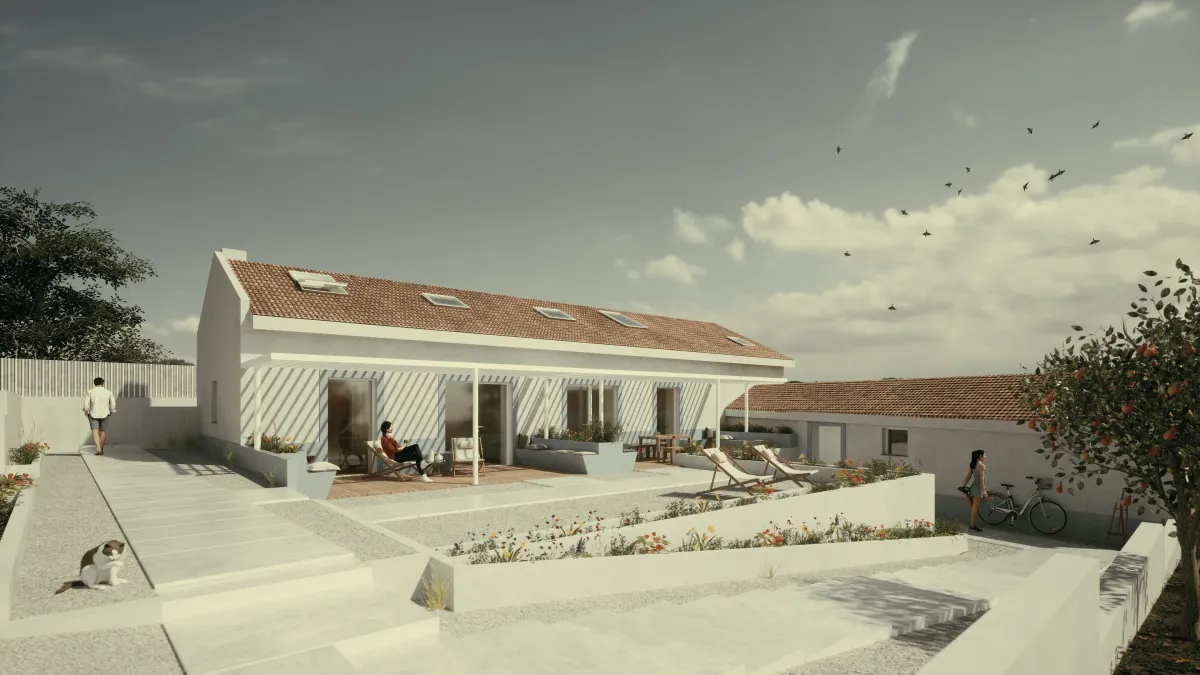
This article compares the two regimes with the text of the law at hand: Decree-Law no. 128/2014, as amended by Decree-Law no. 76/2024, for local accommodation, and the Legal Regime for Tourism Developments (RJET) for the rest. The image shows a local accommodation project by the studio, in Ericeira.
The essentials in 30 seconds
- It is not a free choice: if the establishment meets the requirements of a tourism development, it cannot be operated as local accommodation.
- AL has a ceiling: 9 bedrooms and 27 guests per establishment, except for the “quartos” (rooms) modality and hostels.
- AL registration is a prior notification with a deadline, but it requires a valid use permit for the intended use.
- Since November 2024 the municipality decides: it can create containment areas and sustainable-growth areas, with their own rules for new registrations.
1. The boundary: not a free choice
Local accommodation is the regime for those who provide temporary accommodation, namely to tourists, for payment (DL 128/2014, art. 2(1)). The same article closes the door the other way round: it is forbidden to operate as AL an establishment that meets the requirements to be a tourism development (art. 2(2)).
Local accommodation
Registration with the municipality.No classification.
House, apartment, guesthouse or rooms, up to 9 bedrooms and 27 guests. It cannot use stars or present itself as a tourism development (art. 17).
Tourism development
Design by typology.Mandatory classification.
Hotel, holiday village, tourist apartments, resort, manor-house tourism, rural tourism or campsite, with a use permit for tourism purposes.
The useful question is not “which is more profitable” but “what am I designing”. Size, type of units and operating model define the regime.
2. Side by side
The differences that matter in an investment decision, point by point:
| Local accommodation | Tourism development | |
|---|---|---|
| Legal basis | DL 128/2014, as amended by DL 76/2024 | DL 39/2008 (RJET) and ordinances by typology |
| Forms | House, apartment, guesthouse establishment (including hostel), rooms | Seven typologies: hotels, holiday villages, tourist apartments, resorts, manor-house tourism, rural tourism, campsites |
| Capacity | Maximum 9 bedrooms and 27 guests (except rooms and hostel); “rooms”: maximum 3 | Set by the typology and the design |
| Title to open | Registration number, after prior notification with a deadline to the municipality | Use permit for tourism purposes, issued by the municipality |
| Classification | None | Mandatory: Turismo de Portugal or the municipality, depending on the typology |
| Turismo de Portugal | Receives the registrations, for information | Optional, non-binding opinion on the design (hotels, holiday villages, apartments, resorts, rural hotels) |
| Municipal rules | AL regulation, containment and sustainable-growth areas | PDM and general planning rules |
Sources: DL 128/2014, arts. 3, 5 to 7, 11 and 15-A; RJET, arts. 4, 21, 26, 30 and 36.
3. The limits of local accommodation
AL has three ceilings, and they usually decide whether a project still fits the regime:
01 · Establishment
9 bedrooms
27 guests
Except “rooms” and hostel · art. 11(1)
02 · Rooms
3 bedrooms
at home
In the host’s residence and tax domicile · art. 3(7)
03 · Per building
9 apartments
75% of the units
Per operator, if both limits are exceeded · art. 11(4)
Capacity counts two guests per bedroom, plus two in the living room in apartments and houses; sofa beds or extra beds cannot exceed half of the fixed beds (art. 11(2) and (3)).
The per-building limit also counts registrations held by the spouse, ascendants and descendants and by companies with common partners (art. 11(6)). To operate more units in the same building, the decree itself points to the regime of tourist apartments under the RJET.
4. AL registration and where the architect comes in
Registration is made by prior notification with a deadline, addressed to the mayor through the Single Electronic Desk (Balcão Único Eletrónico) (arts. 5 and 6). The process has four steps:
From application to opening
01 · Application
Prior notification
on the Single Desk, with the use permit
02 · Municipality
60 days
to object; 90 in a containment area
03 · Title
Registration number
the only title for opening to the public
04 · Inspection
Municipal
within the same 60 or 90 days
Sources: DL 128/2014, arts. 5, 6(9), 7 and 8.
What usually holds the process up is not the form: it is the property. The notification must state the use permit or valid title of use (art. 6(1)(a)), and the lack of a suitable use permit is a ground for objection (art. 6(9)(c)). Valid uses are those defined by the municipal regulation or, in its absence, those the municipality accepts (art. 6-B):
- in the “rooms” modality, residential use only;
- houses and apartments with non-residential use must meet the requirements of the decree;
- for guesthouse establishments, the municipality may accept other uses.
In practice
If the property does not have the right use, or needs works, the path starts with a planning procedure at the municipality — and only then with the registration.
The minimum requirements the design must secure:
Units
A window or balcony opening to the outside, a system to block out light and a door with a security system (art. 12).
Water and drainage
Hot and cold water; public sewer or a septic tank sized for maximum capacity (art. 12).
Fire
Above 10 guests, the fire safety regime applies; up to 10, extinguisher, fire blanket, first aid and 112 displayed (art. 13).
Insurance
Civil liability with a minimum of €75,000 per claim; in condominium buildings, also fire insurance (art. 13-A).
5. What changed with DL 76/2024: the municipality decides
Since 1 November 2024, municipalities may regulate local accommodation through their own regulation (art. 4(5)) and delimit, by parish, two types of areas (art. 15-A):
Art. 15-B
Containment areas
The municipality may refuse new registrations in properties rented as housing in the previous two years, set limits relative to the number of dwellings, give new registrations a fixed duration and restrict their transfer.
Art. 15-C
Sustainable growth
The municipality may require a medium or better state of repair, energy class D or better and a minimum share of housing in the building.
While they prepare the regulation, municipalities may suspend new registrations in a delimited area for up to one year (art. 15-B(2)). So before buying for AL, it is the local municipal regulation that must be read — not just the law.
6. AL in a condominium building
In a building under horizontal property, the decree balances the right to operate with that of the other owners. Setting up AL in a unit is not a use different from its purpose (art. 6-B(4)). But the condominium has three tools:
2/3
of the permillage to ban AL in the regulation, for future registrations only
art. 6-B(5)
> 1/2
to ask the municipality to cancel a specific AL for repeated disturbance
art. 9(2)
+30%
maximum additional contribution on the annual fee
art. 20-A
7. When a tourism development makes sense
A tourism development is the regime for those who want, or need, more scale and a classified product: a hotel, a set of tourist apartments, a holiday village, a rural tourism property. The design follows the requirements of the typology, planning control runs through the municipality and, at the end, there is a use permit for tourism purposes and a classification. For hotels, holiday villages, tourist apartments, resorts and rural hotels, the developer may ask Turismo de Portugal for an opinion on the design — optional and non-binding (RJET, art. 26).
Signs that the project no longer fits AL
— More than 9 bedrooms or 27 guests in a single establishment.
— More than 9 apartments held by the same operator in one building, above 75% of the units.
— The brief meets the requirements of a tourism development typology: in that case, the law forbids AL.
For the full process see the tourism development guide , and for rural settings, the three rural tourism (TER) modalities.
From the plot to the use permit: design and permitting of tourism developments.
Frequently asked questions
What is the difference between local accommodation and a tourism development?
A tourism development meets the requirements of one of the RJET typologies and is classified; local accommodation provides lodging without those requirements, registered with the municipality and without classification. Anyone who meets the requirements of a tourism development cannot operate as AL (DL 128/2014, art. 2).
What is the difference between local accommodation and a guest house?
“Guest house” and “Bed & breakfast” are trade names that guesthouse establishments and “rooms” under AL may use (art. 17(4)). They remain local accommodation.
What do you need for local accommodation?
A valid use permit, registration by prior notification with a deadline, civil liability insurance (minimum €75,000), units with a window to the outside, hot and cold water, an information book in Portuguese, English and two more languages, and fire safety rules appropriate to capacity (arts. 6, 12, 13 and 13-A).
How many bedrooms can local accommodation have?
Up to 9 bedrooms and 27 guests per establishment, except in the “rooms” modality (maximum 3, in the host’s residence) and hostels (arts. 11 and 3(7)).
Can the condominium block local accommodation?
It can ban it for the future, by a resolution of two thirds of the permillage, and ask the municipality to cancel a specific AL in case of repeated disturbance, by more than half of the permillage (arts. 6-B and 9).
Deciding between AL and a tourism development?
Send us the location and what you want to set up. We check the property’s use, the municipal rules and the regime your project requires.
Official sources: Decree-Law no. 128/2014 (consolidated version) · Decree-Law no. 76/2024 · Rectification Statement no. 39/2024/1 · Decree-Law no. 39/2008 (RJET), consolidated version.
-
No tags found