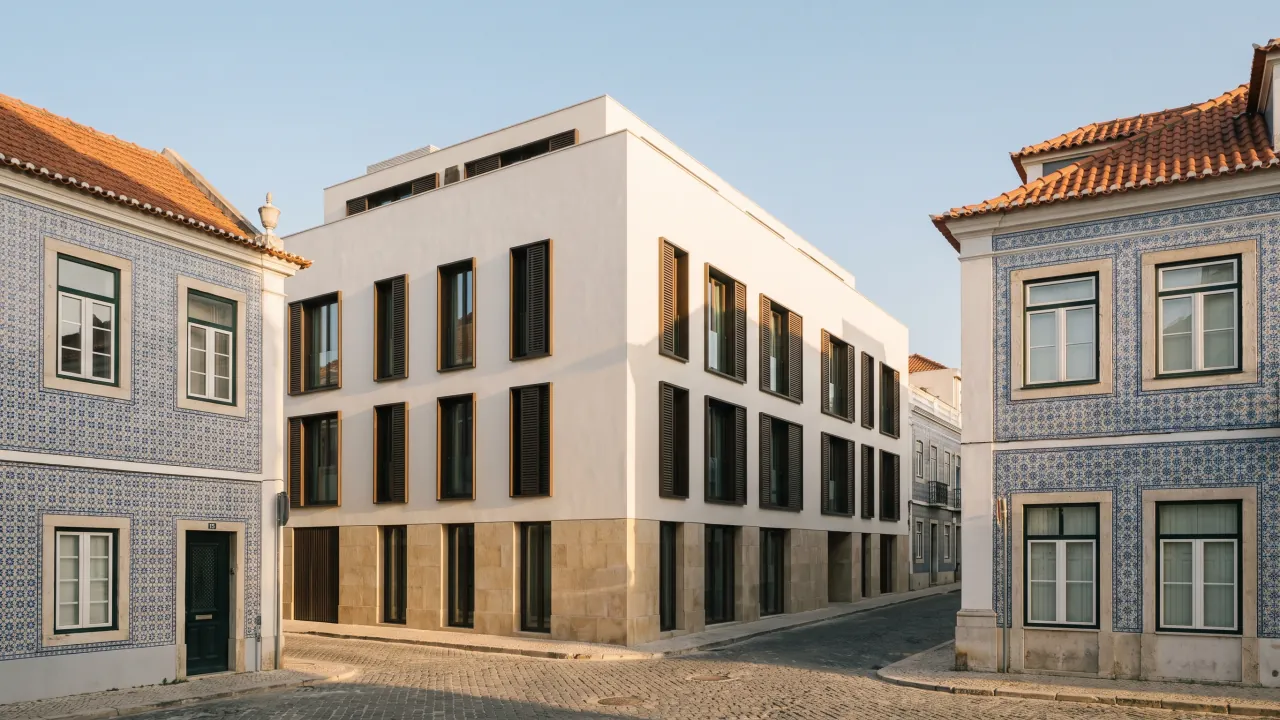
New RJUE: what changes from 1 October 2026

The revision of the Legal Regime for Urbanisation and Building (RJUE, the Portuguese statute that governs planning and building control), approved by Decree-Law n.º 108/2026, of 29 May, entered into force on 1 October 2026. It is the largest change to the permitting of building works in recent years and it changes how a building is notified, permitted and used. This article explains, in plain language, what has applied since that date and — above all — what happens to applications already submitted to the municipality.

The essentials in 30 seconds
- In force since 1 October 2026 — postponed from 3 August by DL 155-B/2026.
- Prior notification becomes full assumption of responsibility — the municipality assesses it in a single step.
- The use permit gives way to a prior notification (or one with a time limit, with inspection).
- The «alvará» (permit certificate) gives way to an operation title, enforceable against third parties and valid in deeds.
- The stage on 1 October is what counts — it decides whether your application follows the new rules or the old ones.
When it entered into force (and why it was postponed)
The date of entry into force was 1 October 2026. It was not always so: Decree-Law n.º 108/2026 itself provided for entry into force «on the first working day of the third month following its publication» (article 13), which pointed to 3 August 2026. That deadline was deferred by Decree-Law n.º 155-B/2026, of 31 July, to give municipalities time to adapt their procedures and IT platforms and to complete the supplementary regulations.
On that same date, Portaria n.º 320/2026/1 (the ministerial order implementing the new regime) also came into force; it regulates several essential aspects of the new regime — from the application forms to the documents required for submission. Until 30 September 2026, the previous regime applied. What changes in the submission to the municipality is explained in Portaria 320/2026: what changes in the application to the municipality.
The reform timeline
01 · Publication
29 May 2026
of DL 108/2026
02 · Postponement
31 Jul 2026
by DL 155-B/2026
03 · Initial date
3 Aug 2026
no longer applies
04 · Entry into force
1 Oct 2026
with Portaria 320/2026/1
The timeline worth fixing: from publication to the effective start of the new rules.
A note for readers: the two articles we have already published on this reform — the analysis of the five structural changes for real estate development and the guide to the new permitting rules for private owners — date from June, before this postponement. Where the dates differ, this one is correct.
What changes, in plain language
The stated aim of the decree is «to make procedures more flexible, speed up deadlines, clarify concepts and ensure the existence of legally secure titles». In practice, for those who build or rehabilitate, this is what changes:
Prior notification
Before
A mainly formal check of the documents submitted.
→
From 1 October
Full assumption of responsibility by the applicant; the municipality assesses formal and substantive validity in a single step.
Use permit
Before
A stand-alone act authorising use — the «use permit».
→
From 1 October
Becomes a prior notification (or a prior notification with a time limit, which allows an inspection).
Operation title
Before
Alvará (permit certificate).
→
From 1 October
An operation title, setting out the characteristics of the works, enforceable against third parties and valid in deeds and registrations.
Permitting deadlines
Before
An overall deadline indexed to the construction area.
→
From 1 October
The overall deadline ends; interim deadlines return, with tacit approval adjusted to complexity.
Reconstruction works
Before
A blurred boundary with extension.
→
From 1 October
Clarified: reinstating the last valid precedent is exempt; if it increases volume or area, it is an extension.
Source: Decree-Law n.º 108/2026, of 29 May (Diário da República).
Prior notification is no longer a «prior control»
The decree acknowledges what was already the practice: prior notification was not a true prior control, because the municipality only checked that the documents had been submitted, without assessing their content. It is now based on an effective assumption of responsibility by the applicant — for the submission and for compliance with the rules — and the municipal assessment, where there is one, covers the operation as a whole, in a single step. Most operations in areas with defined planning parameters may be carried out by prior notification, without depending on an administrative act.
If you are unsure which procedure applies to your works, the article planning permission or prior notification remains the starting point — bearing in mind that the boundary between the two regimes shifts with this revision.
Use is now notified
One of the points with the greatest day-to-day impact: buildings or units whose works were permitted, notified or exempted following a prior information request (PIP) become subject to a prior notification for the purposes of use; in the remaining cases, to a prior notification with a time limit, which allows the municipality to carry out an inspection. In practice, what was known as the «use permit» ceases to be a stand-alone act and is now notified.
The title is once again a document with content
The reform rejects the idea that a mere proof of self-assessed payment of fees can serve as a title. It reinstates the concept of the title as a document that describes the operation — to provide legal certainty and to serve as evidence before third parties, including in deeds and registrations. The alvará thus gives way to the title of the respective operation.
Reconstruction and rehabilitation: clearer boundaries
For those who rehabilitate, there are useful clarifications. Reconstruction remains exempt from planning permission or prior notification, but only as the reinstatement of the last valid precedent; if it adds volume or area, it is an extension and follows that regime. The exemption now covers the reconstruction of buildings in the protection zones of listed buildings, and the replacement of window frames with others of identical design that improve energy efficiency becomes a work of minor planning relevance. A change to the design made after the works have been carried out must be treated as a legalisation, under the terms of municipal regulations.
RGEU and technical rules
The decree provides for the revocation of the General Regulation of Urban Buildings (RGEU), but with effect from the entry into force of the future decree that sets out the technical building standards (article 25) — in other words, there was no revocation on 1 October. We follow this point in the article The RGEU remains in force: its revocation has been postponed.
What happens to an application already submitted
It is the question the practice has received most since the change of regime. The answer lies in article 12 («Application in time») of Decree-Law n.º 108/2026:
- The new regime applies to procedures started after the decree’s entry into force (1 October 2026).
- It also applies to procedures already started which, on that date, are still at the preliminary check and screening stage (article 11 of the RJUE). In those cases, the applicant may carry out the acts necessary to adapt the application to the new regime.
- Applications that on 1 October have already passed that stage follow, as a rule, the previous regime.
- The rules on nullity and lapse periods apply to situations already constituted, unless, under the old law, the period ends earlier; in that case, they are counted from 1 October.
In the experience of those who prepare these applications, the dividing line — whether or not the application is still at the preliminary check and screening stage on 1 October — is what determines, in most cases, whether the application «jumps» to the new rules or remains under the old ones. If you had an application submitted before that date, it is worth confirming what stage it was at on 1 October.
What to do now
There is no single answer, and be wary of anyone who gives one. It depends on the type of operation, the municipality, the applicable parameters and the stage the application was at on 1 October. As a general guide:
- An application submitted now follows the new regime and is prepared using the forms and documents required by Portaria n.º 320/2026/1.
- If your application was still at the preliminary check and screening stage on 1 October, it moved to the new regime and you may adapt it — it is worth assessing whether this works in your favour, for example if the operation can now proceed by prior notification in an area with defined parameters.
- If it had already passed that stage, it follows, as a rule, the previous regime.
- In any case, the decision should be taken case by case, with the application on the table.
Before buying a plot or moving forward with a property, this framing analysis is exactly what we do in LANDSCOPE: telling you what can be built and by which route, before you invest. Alongside this, other 2026 regimes with weight on the final bill remain in force, such as 6% VAT on construction.
Frequently asked questions
When did the new RJUE enter into force?
On 1 October 2026. The initial date was 3 August 2026, but it was postponed by Decree-Law n.º 155-B/2026, of 31 July.
Does the use permit come to an end?
It ceases to be a stand-alone act. Use now takes place under a prior notification or, in other cases, under a prior notification with a time limit, which allows an inspection by the municipality.
Does the alvará disappear?
The alvará gives way to an operation title — a document that describes the works and serves as evidence before third parties, including in property transactions.
I have an application already submitted. Do the old rules or the new ones apply?
It depends on the stage on 1 October. If it is still at the preliminary check and screening stage, the new regime applies (with the possibility of adapting the application); if it has already passed that stage, it follows, as a rule, the previous regime (article 12).
Did the RGEU stop applying on 1 October?
No. The revocation of the RGEU only takes effect when the decree setting out the new technical building standards enters into force.
Do you have an application under way or works to start this autumn?
Send us the property tax document (caderneta predial) and the current stage of the application, and we will tell you, specifically, what changes in your case and the best time to submit.
Official sources: Decree-Law n.º 108/2026 · Decree-Law n.º 155-B/2026 · Portaria n.º 320/2026/1 (Diário da República).
-
No tags found