
Restoring an Alentejo farmhouse (monte): what you can and cannot do
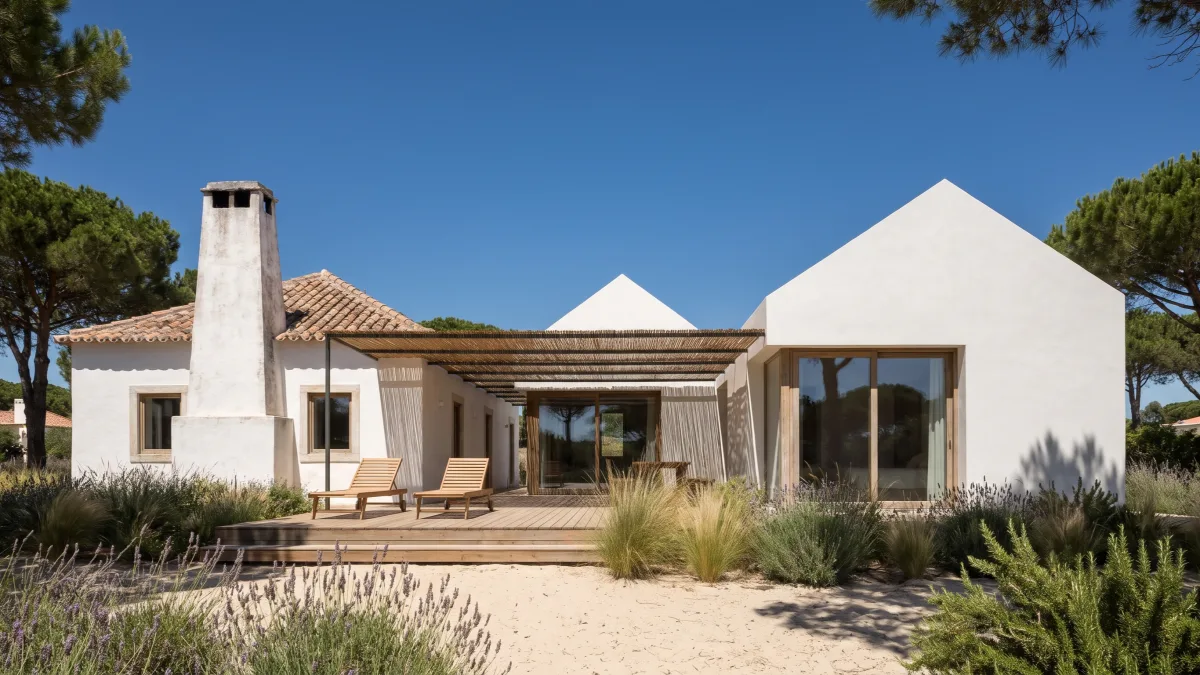
Anyone looking for a monte (a traditional Alentejo farmhouse) to restore looks first at the walls and the price. What decides the deal is what the law lets you do with that building. A monte on rustic land can, as a rule, be restored; how much it can grow and what it can become depend on three checks: whether the building exists legally, what the municipal PDM (master plan) allows in that land-use category, and whether the land lies in the National Agricultural Reserve (RAN) or the National Ecological Reserve (REN).

This guide is for anyone about to buy a monte that already exists: to restore it, extend it, legalise it or change its use. To build from scratch on rustic land, see what the Land Law allows. We cite the RJUE (Portugal’s legal regime for urbanisation and building) as amended by Decree-Law no. 108/2026, in force since 1 October 2026, and two Alentejo PDMs as examples.
The essentials in 30 seconds
- First, the legality of what exists. What counts is the “last valid antecedent”: the last licensed works or the construction that, when it was built, did not need a permit.
- Conservation and reconstruction are exempt from a permit; an extension on rustic land needs one (RJUE, arts. 6 and 4).
- An extension must comply with today’s PDM. The protection of existing buildings covers reconstruction and alteration, not extension.
- RAN and REN come before the PDM. They only allow the uses the law lists.
- “Approved project” in a listing is no guarantee: approvals and permits lapse if the RJUE deadlines are not met.
Before buying: eight checks
The general buying steps are in how to buy a plot of land. For a monte, add these, in this order; the following sections explain why.
Before buying a monte
01
Registry and tax record
Permanent land registry certificate and caderneta predial (tax record): urban and rustic tax entries and recorded areas. They prove what is recorded, not that the house was licensed
02
Planning file
The building’s municipal planning file or, if there is none, proof of the date of construction
03
Survey
Footprint and construction area of each building, annexes and porches included
04
PDM
Land-use category and the article that governs existing buildings in that category
05
Constraints
RAN, REN, Natura 2000, wildfire hazard, watercourses and easements
06
Use
Whether the category allows the intended use (housing, rural tourism, local accommodation) and within what limits
07
Infrastructure
Water source, sewage solution and access for emergency vehicles
08
Titles
If the listing mentions an approved project or a permit: file number, status and deadlines, confirmed with the municipality
If the room for manoeuvre is uncertain, a prior information request (PIP) can be filed before the deed by any interested party, even one who is not the owner; the municipality notifies the owner (RJUE, art. 14(1), (3) and (4)). If the answer is favourable and covers all the elements of art. 14(2), the works are then exempt from a permit (arts. 6(1)(h) and 17(2)). See the guide to the prior information request.
Does the monte exist legally?
Everything you can do with a monte depends on what the law recognises as existing. The RJUE calls it the “last valid antecedent” (último antecedente válido): the last valid and effective urban development operation or, where there was no planning file, the operation that, at the date it was carried out, did not require a title (art. 2(r)). Reconstruction is measured against it.
The protection of existing buildings is set out in article 60. Buildings constructed under earlier law are not affected by later rules, and reconstruction or alteration works cannot be refused on the basis of those rules, provided they do not create or worsen non-conformities, or provided they improve safety and health conditions. The article says nothing about extension. A monte larger than the PDM would allow today can be rebuilt with the area it has; whatever is added to it must comply with the plan in force.
The “pre-1951” myth
The law sets no such date. 1951 is the year of the RGEU (General Regulation on Urban Buildings, Decree-Law no. 38 382 of 7 August), which originally applied within the urban perimeter and the rural protection zones of municipal seats and of localities with an urbanisation plan; outside them, only where the municipality extended it by resolution (art. 1 and sole paragraph). What counts is whether, at the date and in the place of construction, the works needed a permit. Whoever invokes the date has to prove it: in a legalisation, the law places that burden of proof on the applicant (RJUE, art. 102-A(5)).
Restore, extend or legalise: what each type of works requires
The RJUE classifies works by their result (art. 2), and that classification decides whether a permit is needed. The table sums up the regime on rustic land outside a detailed plan (plano de pormenor), the typical situation of a monte.
| Works | What it is | Prior control |
|---|---|---|
| Conservation | Keeping the building as it was: restoration, repair, cleaning | Exempt (art. 6(1)(a)) |
| Interior alteration | Without touching façades, roofs or heights | Exempt; if it affects the structure, with a project and a statement of responsibility (point (b)) |
| Reconstruction | Demolishing and restoring the façades and roof according to the last valid antecedent | Exempt (point (e)) |
| Exterior alteration or extension | Changing façades; increasing area, volume or height | Permit (art. 4(2)(c)) |
| Legalisation | Regularising what was built without a title | Specific procedure (art. 102-A) |
The exemption does not waive compliance with the PDM, easements and public-interest restrictions or technical standards (art. 6(8)), and exempt works start with the notice of commencement of works (art. 80-A). Prior notification is reserved for consolidated urban areas and for areas covered by a detailed plan, an execution unit or a subdivision (art. 4(4)); in RAN, REN or under another public-interest restriction, the works require a permit (art. 4(2)(h)). The general criterion is in the article on permit or prior notification.
Legalisation is only possible if the building can comply with the rules in force today, PDM included (art. 102-A(1)). Technical building standards that have become impossible or unreasonable to meet may be waived, if those in force at the date of the works were met (para. 5). An addition the PDM does not allow cannot be legalised: it is demolished, and that should be reflected in the price.
How much you can extend: the municipal PDM decides
There is no single Alentejo rule: each PDM has its own article for existing buildings on rustic land. Two examples, from the texts in force.
Grândola
The PDM requires the recovery of existing buildings to be favoured (art. 40(5)). Reconstruction, alteration and extension follow the regime for new buildings of the same use, without the requirement that the applicant be a farmer (art. 42(2)). For housing, the parameters of art. 43 apply: up to 500 m² of construction area, one storey and a façade up to 3.5 m, with narrow exceptions. On plots under 4 ha (2 ha in Carvalhal and Melides), the extension of all the residential buildings together cannot exceed 250 m² of construction area in total (art. 42(3)). If the monte already has more area than the maximum, that area becomes the one that counts (art. 42(4)(a)).
In the same municipality, the room for manoeuvre changes with the zone: in the zone of high tourist pressure, new tourism developments are only allowed in the form of a campsite (arts. 47(2) and 48-A(1)); and outside urban land and rural settlements, building houses or tourism buildings is forbidden on land with high or very high wildfire hazard (art. 10(1)).
Évora
In agricultural and forest areas, the Évora PDM allows the conservation, alteration and extension of existing buildings used for housing, subject to the rules of each subcategory, with a façade height, as a rule, of up to 4.5 m (art. 82(1) and (2)). For tourism, an extension for a country house (casa de campo), agritourism or manor-house tourism (turismo de habitação) cannot exceed 50% of the pre-existing legally built footprint (art. 78-C(4)(b)).
Note the words “legally built”: the area that counts is the one that legally exists.
RAN and REN: the constraints plan comes first
The PDM zoning plan gives the land-use category; the constraints plan shows the restrictions laid over it. For a monte, start with the latter.
RAN areas are non aedificandi, and building or extending in them is forbidden, except for the uses the law lists (Decree-Law no. 73/2009, arts. 20 to 22). Two matter for a monte: the reconstruction and extension of existing buildings that were, and remain, intended as the owner’s own home, and rural tourism and manor-house tourism developments complementary to farming (art. 22(1)(n) and (g)). Only where there is no viable alternative outside the RAN, and with a prior binding opinion from the regional RAN body (arts. 22 and 23).
In the REN, construction and extension works are forbidden (Decree-Law no. 166/2008, art. 20(1)). Only uses listed in Annex II of the decree that do not compromise the functions of that area are allowed, either exempt or subject to prior notification to the CCDR, the regional coordination and development commission (arts. 20(3) and 22). The answer depends on the REN type and cannot be generalised.
Before the deed
If you are assessing a monte, LANDSCOPE cross-checks the caderneta with the PDM, the constraints plan, the RAN and the REN, and tells you what can be done before you sign.
Housing, rural tourism or local accommodation
The use you want to give the monte changes the applicable law, the requirements and who decides.
| Use | Law | Key condition for a monte |
|---|---|---|
| Housing | RJUE and PDM | Use allowed in the land-use category; after the works, the use is authorised by prior notification (RJUE, art. 62-A) |
| Country house or agritourism (TER, rural tourism) | DL 39/2008 (RJET, the tourism developments regime), art. 18; Portaria 937/2008 | Reconstruction, rehabilitation or extension of existing buildings; agritourism requires a working farm |
| Rural hotel (TER) | RJET, art. 18(7) | Can be set up in an existing building or in one built from scratch |
| Manor-house tourism | RJET, art. 17; Portaria 937/2008, art. 2 | Old property of architectural, historic or artistic value; the owner or operator lives there while it operates |
| Local accommodation (alojamento local), detached house | DL 128/2014, as amended by DL 76/2024 | Use permit or valid title; up to 9 bedrooms and 27 guests |
Rural tourism is designed for the monte: the RJET defines it by the reconstruction, rehabilitation or extension of existing buildings and applies the RJUE protection of existing buildings to it (art. 18(1) and (9)); it is the municipality that sets the capacity and classification of TER, except rural hotels, and of manor-house tourism (art. 22(2)). For the modalities, see rural tourism. Local accommodation looks like the short cut, but the registration notice must state the use permit or a valid title (DL 128/2014, art. 6(1)(a)): a monte without a title starts with the planning side. The choice is set out in local accommodation or tourism development; to budget the works, how much it costs to build a house.
Frequently asked questions
Can I extend an Alentejo monte?
It depends on the municipal PDM and the land-use category. On rustic land an extension requires a permit and must comply with the plan in force, because the protection of existing buildings in art. 60 of the RJUE does not cover it.
The listing says “with approved project”. What does that guarantee?
Only what is still valid at the municipality. After the architectural project is approved, the engineering projects must be submitted within six months, extendable once by three; if they are not, the process is suspended and, six months later, it is declared to have lapsed (RJUE, art. 20(4) to (6)). A permit lapses if the fees are not paid within one year, if the works do not start within the 12 months following payment, or if they are halted or abandoned for more than six months (art. 71(2) and (3)). A favourable prior information request is valid for two years (art. 17(5)). Ask for the file number and confirm the status and deadlines before paying for it.
Does a house built before 1951 need a permit?
The law sets no such date. What counts is whether, when and where it was built, the works needed a permit: the 1951 RGEU originally applied in urban perimeters and in areas where the municipality extended it. Whoever invokes the date has to prove it.
Can I turn a monte into rural tourism?
Yes, if the PDM allows that use in the land-use category: the country house and agritourism start precisely from existing buildings (RJET, art. 18). In RAN, only when complementary to farming.
Can I run local accommodation in a monte?
Yes, if the monte has a use permit or a valid use title. The maximum capacity is 9 bedrooms and 27 guests (DL 128/2014, art. 11), and it is worth reading the municipal local accommodation regulation, if there is one.
Request a proposal
Looking at a monte to buy?
Send us the listing or the caderneta predial and the location. We will tell you what the PDM allows, what can be legalised and which route to take, before the deed.
Prefer to talk now? +351 918 660 664geral@tiagorcorreia.com
Official sources: Decree-Law no. 108/2026 (RJUE republished) · RJUE, consolidated version · RGEU, Decree-Law no. 38 382 · Decree-Law no. 73/2009 (RAN) · Decree-Law no. 166/2008 (REN) · Decree-Law no. 39/2008 (RJET) · Portaria no. 937/2008 · Decree-Law no. 128/2014 (consolidated version) · Decree-Law no. 76/2024 · Grândola PDM, Declaração no. 24/2026/2 · Évora PDM, Aviso no. 21372/2025/2.
-
No tags found
10 de November de 2026