What are hotel establishments? Typologies and permitting
«Hotel establishment» is a precise legal category — and choosing it well defines the construction requirements, the classification and the viability of the investment. Since 2014, the RJET recognises three types: hotels, aparthotels and pousadas. Here is what each demands and when it makes sense.
1. The three current typologies
HOTEL ESTABLISHMENTS
HOTELS1 to 5 stars
APARTHOTELSunits with kitchenette
POUSADASlisted / historic buildings
Hotels — the classic typology, with a 1-to-5-star classification awarded by Turismo de Portugal after inspection: permanent reception, units with private bathrooms and proportionate common areas. Aparthotels — the same logic with domestic autonomy (kitchenette), ideal for medium stays. Pousadas — installed in listed buildings or buildings of recognised value, where the architecture is the commercial argument itself.
An important note: older figures such as inns (estalagens) and motels have disappeared from the legal framework — anyone finding those designations on properties for sale should treat them as history, not as a licence.
The RJET — approved by DL 39/2008 and deeply revised in 2014 — reduced the hotel typologies to hotels, aparthotels and pousadas, with minimum requirements per category.
Source: RJET — DL n.º 39/2008, current wording — Diário da República
2. What opening requires
- Tourist use admitted in the PDM for the location;
- Municipal permitting with an opinion from Turismo de Portugal;
- Compliance with safety, accessibility and minimum-area requirements per category;
- Inspection and classification before opening to the public.
3. Where architecture decides the business
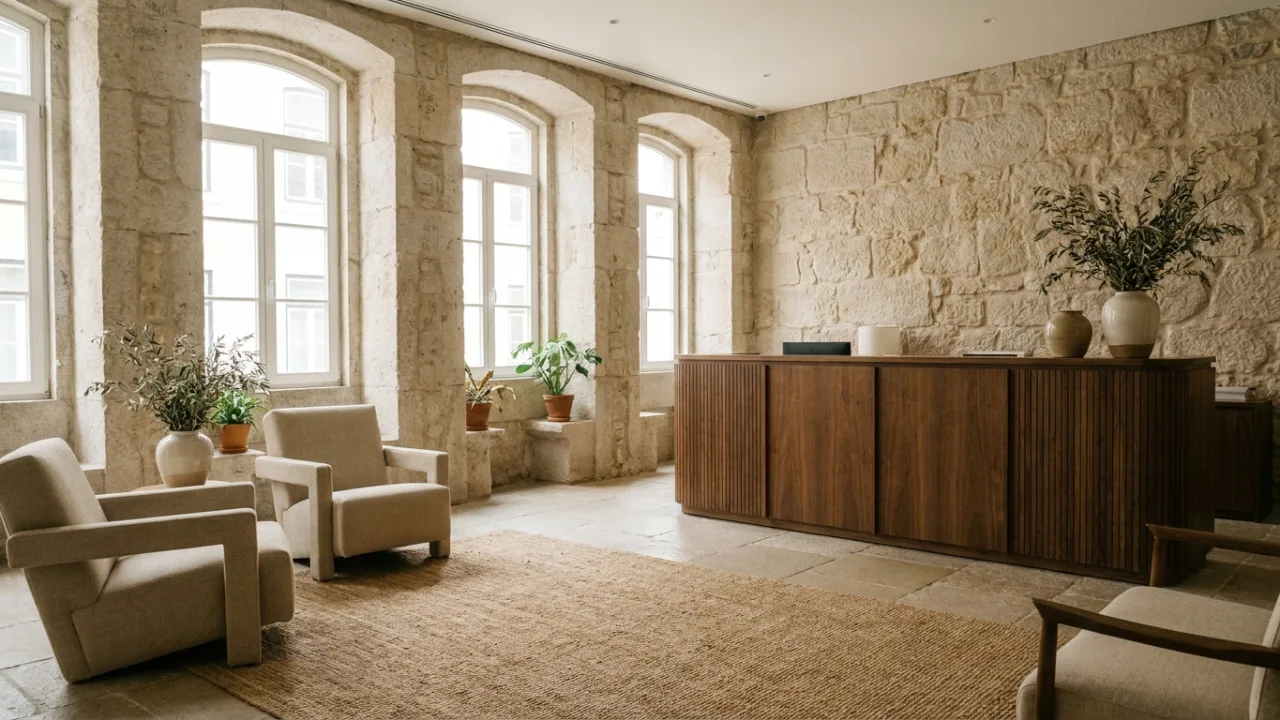
Meeting requirements opens doors; what fills rooms is something else: service circuits that never cross guests, rooms designed for light and silence, common areas that produce revenue and an identity that outlives the photographs. In rehabilitation — pousadas and boutique hotels — add the dialogue with heritage, from the new technical references to permitting in protection zones.
“A hotel is a building that works in shifts: what the guest sees is half of the design; the other half is what makes the operation run unseen.”
Tiago R. Correia
Architect
Frequently asked questions
What is the minimum size of a hotel?
The RJET sets minimum requirements per category — including the dimensions of the accommodation units, which grow with the stars. The exact programme is settled by the applicable classification regulation.
Can I turn a residential building into a hotel?
Often yes, with a change of use and PDM compliance — one of the most common operations in urban rehabilitation. See how permitting works in 2026.
Hotel or rural tourism?
It depends on the asset and the capital: in rural settings, TER requires less investment and has an identity of its own; a hotel brings scale and institutional liquidity.
Thinking about a hotel or pousada?
From the programme to the classification, we design hotel establishments that work for the guest and for the operation.
-
No tags found