Rural tourism in Portugal: types, requirements and licensing
Tourism10 min readUpdated November 2026
Rural tourism (turismo no espaço rural, TER) is the category of tourism development in Portugal designed to put rural buildings to use without stripping them of character. The law divides it into three types, country house, agritourism and rural hotel, and the type decides almost everything: whether you can build from scratch, which minimum areas apply, who classifies the development and which opinions you can request.
This article sets the three types side by side, with the legal requirements and the route through the municipality, for anyone who owns a quinta, a monte or a village house and wants to know what they can do with it. It is based on the Portuguese legal regime for tourism developments (RJET, Decree-Law no. 39/2008, as currently in force) and on Ordinance no. 937/2008, which sets the minimum requirements for TER. The general framework, with the seven types of tourism development, is in the guide to tourism developments.
The essentials in 30 seconds
Only the rural hotel can be built from scratch. Country houses and agritourism start from existing buildings, through reconstruction, rehabilitation or extension (RJET, Article 18).
The minimums are in Ordinance no. 937/2008: breakfast is compulsory and, in country houses and agritourism, bedrooms have at least 7 m² (single) and 9 m² (double).
The municipality decides in 20 days on a prior notification with a deadline, or in 60 if external bodies are consulted (RJET, Article 23-A).
The PDM comes before the type: the municipal master plan says whether tourist use is allowed on that land and with which parameters.
3
types: country house, agritourism and rural hotel
RJET, Art. 18(3)
1
type can be built from scratch: the rural hotel
RJET, Art. 18(7)
9 m²
minimum double bedroom in country houses and agritourism
Ordinance 937/2008, Arts. 23 and 24
20
days for the municipality to decide a prior notification with a deadline (60 with consultations)
RJET, Art. 23-A
1. What the law means by rural tourism
Rural tourism developments are establishments that provide accommodation to tourists in rural areas while preserving, restoring and enhancing the architectural, historical, natural and landscape heritage of the place, through the reconstruction, rehabilitation or extension of existing buildings that fit into their surroundings (RJET, Article 18(1)).
A rural area, for this purpose, is an area with a traditional and significant link to agriculture, or with an environment and landscape of a markedly rural character (Ordinance no. 937/2008, Article 4(1)). Classification takes into account the landscape setting, the surrounding rural amenities, environmental quality and the promotion of local products and services (Article 4(2)).
2. The three types side by side
Country house
Agritourism
Rural hotel
Where
Villages and rural areas, in keeping with the typical local architecture
On a working farm
Rural areas, with a design and materials that respect the region
New build?
No: starts from an existing building
No: starts from an existing building
Yes: existing building or built from scratch
Bedrooms (minimum)
7 m² single · 9 m² double
7 m² single · 9 m² double
Hotel classification requirements (3 to 5 stars)
Bathrooms
At least 1 for every 3 bedrooms
At least 1 for every 2 accommodation units
Hotel classification requirements
Reception
Can be an office in the parish
Reception area on site
Reception area on site
Unit adapted for reduced mobility
Not compulsory
Not compulsory
Compulsory
Who sets capacity and classifies
Municipality
Municipality
Turismo de Portugal
Sources: RJET, Articles 6, 18, 21 and 27; Ordinance no. 937/2008, Articles 5, 7, 8, 13, 23, 24 and 25.
Country house (casa de campo). A property in a village or rural area which, through its design, materials and other features, fits into the typical local architecture (Ordinance, Article 5). When five or more country houses in the same village or parish, or in adjoining villages or parishes, are run jointly by a single operator, they may use the name village tourism (turismo de aldeia), even if they belong to different owners (Article 6).
Agritourism (agroturismo). A property on a working farm where guests can follow and learn about farming, or take part in the work, under the rules set by the person in charge (Article 7). The accommodation units may be outside the main building, in adjoining or nearby buildings in harmony with it; in that case they have up to three bedrooms and at least a private living room and one bathroom, or two if they have three bedrooms (Article 24(2) and (3)).
Rural hotel (hotel rural). A hotel in a rural area that respects, through its design and materials, the dominant features of the region (Article 8). It meets the common TER requirements and those of hotel classification, in the 3 to 5 star categories (Article 25(1)). If it is built from scratch, the accommodation units are in a single building or in buildings forming a single architectural whole (Article 10(4)).
3. Build from scratch or rehabilitate?
This is the question that weighs most when buying land, and the answer lies in the type. Always read it after the PDM (section 6):
What the starting point allows
Land with no buildings
Rural hotel
The only type that can be built from scratch (RJET, Art. 18(7)).
With an existing building
Country house or rural hotel
Through reconstruction, rehabilitation or extension (Art. 18(1)).
On a working farm
Agritourism too
With accommodation in the main building or in nearby buildings.
Works on TER developments benefit from the protection of existing buildings set out in Article 60 of the RJUE, Portugal’s legal regime for urbanisation and building (RJET, Article 18(9)). It matters when the existing building does not meet current rules: reconstruction or alteration works cannot be refused on the basis of rules that postdate the original construction, provided they neither create nor worsen non-conformities, or they improve the building’s safety and health conditions (RJUE, Article 60(2)). If your starting point is a monte to restore, see what you can and cannot do with an Alentejo farmhouse.
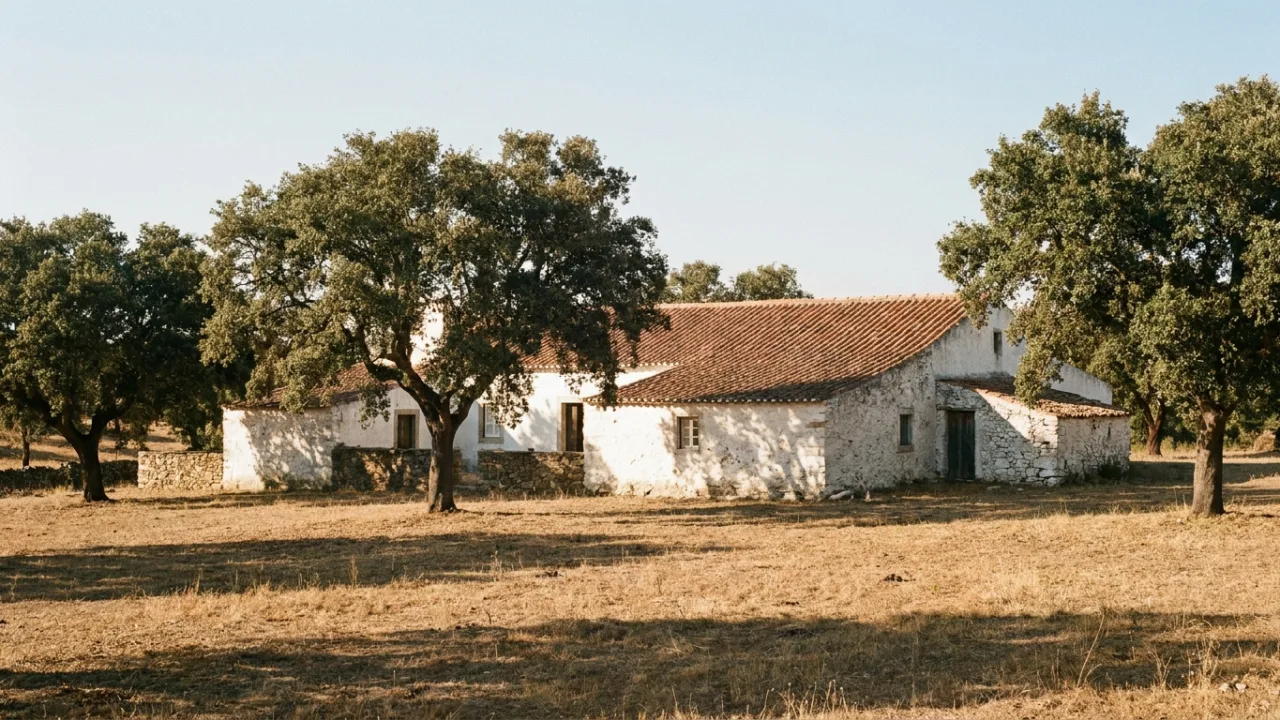
Starting from what exists.Casa Dunas, Vale Furado (Alcobaça): reconstruction of a ruin built before 1951, keeping exactly its original footprint. It is a family house, at the prior information request stage; project image by the studio.
4. Requirements common to the three types
Ordinance no. 937/2008 sets the minimum requirements. Those that weigh most on the design:
Infrastructure and equipment (Article 11): hot and cold running water; tanks for daily needs where the supply is private; fire safety under the relevant legislation; heating and cooling suited to the location; a storage area separate from guest areas; parking.
Accommodation units (Article 14): bedrooms or suites with a bed, a bedside table or equivalent, a mirror, a wardrobe, bedside lighting and a socket; if they have a private living room, it is at least 10 m².
Bathrooms (Article 20): toilet, shower or bath, washbasin, mirror, light point, socket and hot and cold water.
Operation (Articles 18 and 21): breakfast is compulsory; lunch and dinner on request when there is no restaurant within 5 km, except in country houses not lived in by the owner or operator; daily tidying and cleaning; bed linen and towels changed at least twice a week.
Residence: in TER the owner or operator may or may not live in the development (Article 3(2)). Residence is only required in manor-house tourism (turismo de habitação).
5. Accessibility: what the law requires and what it does not
The technical accessibility standards of Decree-Law 163/2006 apply to the design and construction of all tourism developments. What manor-house tourism and TER do not have is the obligation to provide facilities and at least one accommodation unit for guests with reduced mobility.
There is an exception within the exception: the rural hotel does have that obligation (Ordinance no. 937/2008, Article 25(2)). In a country house or an agritourism set in an old building, the RJET does not impose the adapted room; the design still follows the standards of Decree-Law 163/2006, which provide for a regime of exceptions for existing buildings.
6. The PDM decides before the type
The type tells you what tourism law requires. It does not tell you whether the use is allowed on that land. That depends on the municipal master plan (PDM): land-use category, minimum plot size, building indices, height. It also depends on the constraints on the land: the National Agricultural Reserve (RAN), the National Ecological Reserve (REN), easements. Each municipality has its own rules for tourism on rustic land, and this is where many deals are decided before there is any design.
This is the reading that LANDSCOPE does before you buy: the Simple version in 48 hours, with the PDM, constraints and a feasibility indicator; the Complex version in 5 working days, with REN, RAN, easements, scenarios and a siting and massing study.
7. Licensing and classification
From design to opening
1
Municipality
Prior notification with a deadline, or a licence if the developer prefers.
2
Opinions
Turismo de Portugal for the rural hotel, on request; the municipality may consult other bodies.
3
Capacity
Set with the building permit, according to the design.
4
Classification
Confirmed at opening, through an audit or the inspection.
Prior control by the municipality. Building a tourism development follows the prior notification with a deadline (comunicação prévia com prazo) or, where applicable, the RJUE prior notification; the developer can always opt for a licence instead (RJET, Article 23(2)). The application states the intended classification (Article 23(3)). Under a prior notification with a deadline, the mayor decides within 20 days, or 60 if external bodies are consulted; with no decision within that period, the notification is deemed accepted and works can start once the fees are paid (Article 23-A).
Opinions. For a rural hotel, the developer can ask Turismo de Portugal for an opinion on the design; it is optional and non-binding (Article 26). For country houses and agritourism, the municipality can ask for an opinion on the use and type and, regarding location, from the Directorate-General for Agriculture and Rural Development (Ordinance, Article 4(3)).
Capacity and classification. For country houses and agritourism, the municipality sets the maximum capacity and grants the classification with the licence or the express acceptance of the prior notification, to be confirmed at the end (RJET, Article 27). For the rural hotel, it is Turismo de Portugal (Article 21(2)(c)).
Opening. Once the opening title is issued, the classification audit is ordered within 60 days, by the mayor for TER and by Turismo de Portugal for the rural hotel. For country houses and agritourism, if there was an inspection, the classification is set with the use permit and there is no audit (Article 36(1) and (6)).
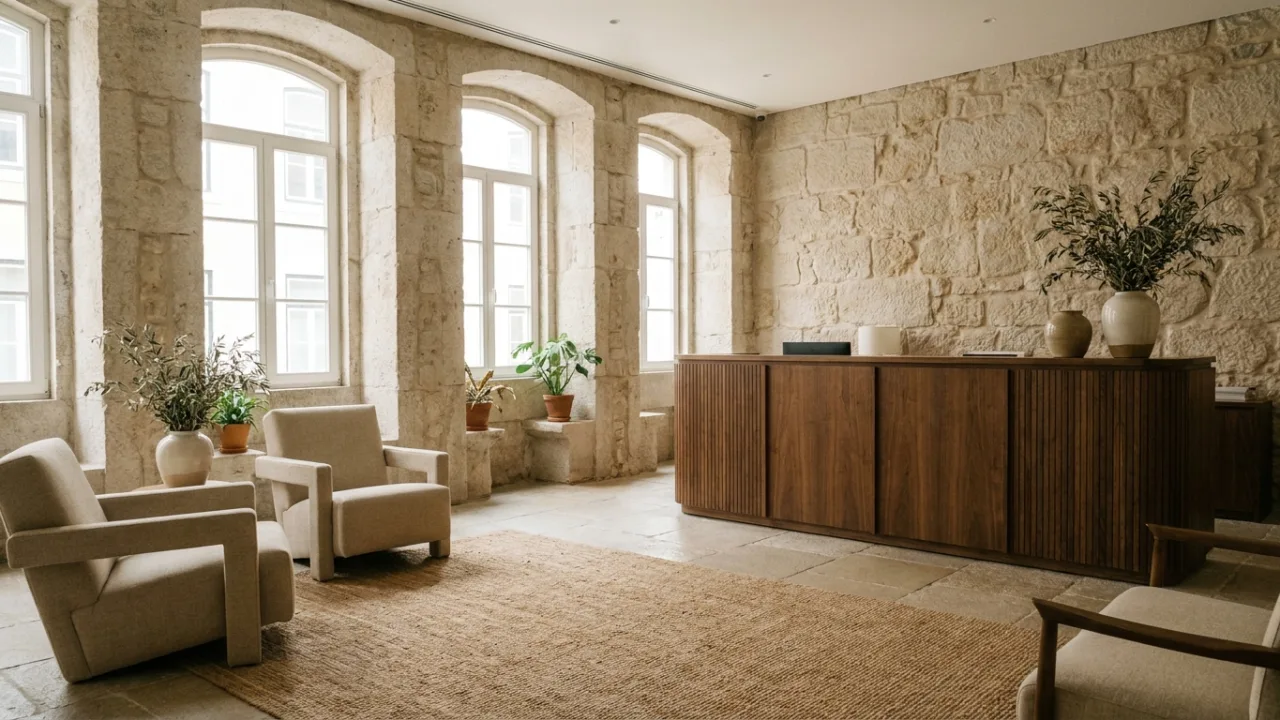
The value of a TER lies in its authenticity, and the right intervention is the one that serves it: local materials (stone, lime, timber, clay tiles), reuse of existing structures, integration into the topography and discreet energy efficiency. It is not about imitating the old, but about a contemporary language that respects the place. That tension, well resolved, is what sets lasting projects apart from generic ones.
In our own work: Encarnação, Mafra
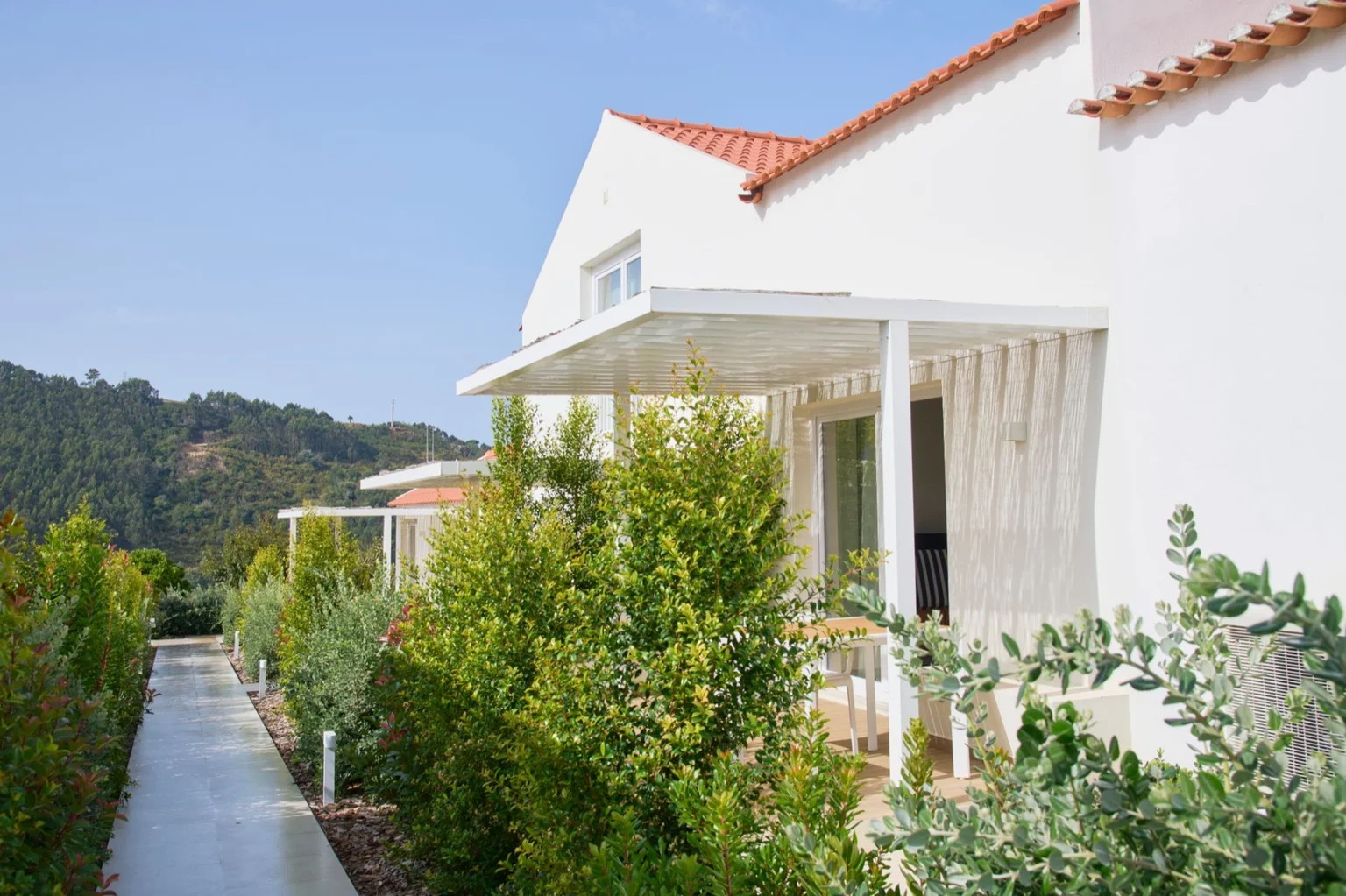
Holiday rental in Encarnação, near Ericeira: white volumes with clay tiles, pergolas and terraced paths, in an architecture close to the region’s tradition without imitating it. Completed in 2026. It is a local accommodation (alojamento local), not a TER development, but the design approach is the same.
The porch, reinterpreted.Ericeira Tourism: a group of tourist apartments at a scale close to the surrounding houses, with the porch of vernacular building in a contemporary key. Preliminary design; project image by the studio.
“In rural tourism, luxury is the truth of the place: walls that tell stories, real silence and design that does not compete with the landscape.”
Tiago R. Correia
Architect
Frequently asked questions
What counts as rural tourism in Portugal?
Tourism developments that provide accommodation in rural areas while preserving and enhancing the architectural, natural and landscape heritage of the place, through the reconstruction, rehabilitation or extension of existing buildings (RJET, Article 18(1)). They are divided into country houses, agritourism and rural hotels.
What are the minimum requirements for rural tourism?
They are in Ordinance no. 937/2008: hot and cold water, fire safety, heating and cooling, parking, a reception area, compulsory breakfast and daily cleaning. In country houses and agritourism, bedrooms have at least 7 m² (single) and 9 m² (double); the rural hotel must also meet the hotel classification requirements.
What is a country house in rural tourism?
A property in a village or rural area, in keeping with the typical local architecture through its design and materials, that provides accommodation to tourists (Ordinance no. 937/2008, Article 5). It is set up in an existing building.
Can I build from scratch on rustic land for rural tourism?
Only for a rural hotel, the only TER type that can occupy a building built from scratch (RJET, Article 18(7)). Country houses and agritourism start from existing buildings. In every case, the municipal PDM decides whether the use is allowed on that land and with which parameters.
Do I have to live on the property?
No. In TER the owner or operator may or may not live in the development (Ordinance no. 937/2008, Article 3(2)). Residence during the operating period is only required in manor-house tourism (turismo de habitação).
What is the difference between rural tourism and local accommodation?
Local accommodation (alojamento local) is the regime for those who provide accommodation without meeting the requirements of a tourism development, with its own registration. TER is a tourism development: it has a classification and meets the minimum requirements of Ordinance no. 937/2008, such as compulsory breakfast and minimum bedroom areas. See the legal line between local accommodation and a tourism development.
What changed with Decree-Law no. 80/2017?
It created the prior notification with a deadline for building tourism developments: the municipality decides within 20 days, or 60 if there are consultations, and with no decision the notification is deemed accepted (RJET, Article 23-A). The developer can still opt for a licence (Article 23(2)).
Request a proposal
Do you have a quinta or a rural house with potential?
Send us the location or the caderneta predial. We will tell you which type the PDM and the existing building allow, which procedure applies, and propose fees with phases and timelines.